Wednesday, January 22, 2014

Arbegona

In the last four weeks or so I have begun work in the county of Arbegona.  Yaya is the central town in the area and has a population of 12,000-15,000. Arbegona approximately has a population of 150,000 and it sits atop a mountain about 2 hours outside of Hawassa. Due to the high altitude it is much colder than I ever had hoped for in Ethiopia especially at night and early in the mornings. I feel like I should not ever see my breath in Africa.  The people in this area speak a tribal language called “Sudaminya.” However if a person has some basic education they do speak a bit of “Amharic” the national language however “Sudaminya” is much more common, and you’d be surprised how many people do not have even a basic education. People make their living under one of three main categories, farming, government work, or horse breeding and cattle raising. The area is naturally very rich in resources and the people almost souly live off of the land and the resources Mother Nature provides them with. Injera is not a traditional food for these people, unlike other areas of Ethiopia. There is something called a “false banana” plant that people eat and prepare, below is a picture of the false banana plant. This plant also has many other useful qualities, the leaves are used to wrap and carry other produce, the outside of the trunk can be made into rope or twine, and then the inside of the trunk is made into the local food called "kocha"
False Banana plant, broken down eaten and used for various other things

Arbegona (Southern Ethiopia)

More of the Arbegona landscape its beautiful there and very rich in natural resources
 
I was told a story by an Ethiopian from Arbegona and thought it was rather interesting. It begins with… a well-educated man from Addis Ababa (the capital city of Ethiopia) who went to Arbegona for work. He ran into a farmer lying in the grass and this was the conversation between the 2 men.
Addis man: Why are you not working?
The farmer: because I am finished and have no more to do.
Addis man: If you work hard you can improve your life
Farmer: If I work hard what am I going to gain?
Addis man: more possessions (clothes, shoes etc.)
Farmer: I am wearing clothes and shoes… What else am I going to gain by working harder
Addis man: Well more food for you and your family
Farmer: I already have enough food to feed myself and family. What else can I gain by working hard?
Addis man: a car and a better house.
Farmer: Why there are no roads up here. What else can I gain by working harder?
… This goes on a few more times between the two until this statement.
Addis man: You will gain happiness
Farmer: I have already achieved happiness

I’m not sure exactly how telling this story is of the people in Arbegona but thought it was interesting to hear. Below are a few pictures of work and the houses the people live in as they are very different compared to the houses in the Tigray region.

supportive supervision visit at health center

Quick on the job feedback during a supportive supervision visit 

Me in Arbegona in front of the local houses "Gojo bet"

Local house in the southern region of Ethiopia it is called a "Gojo Bet"

Contruction of a new "Gojo Bet"
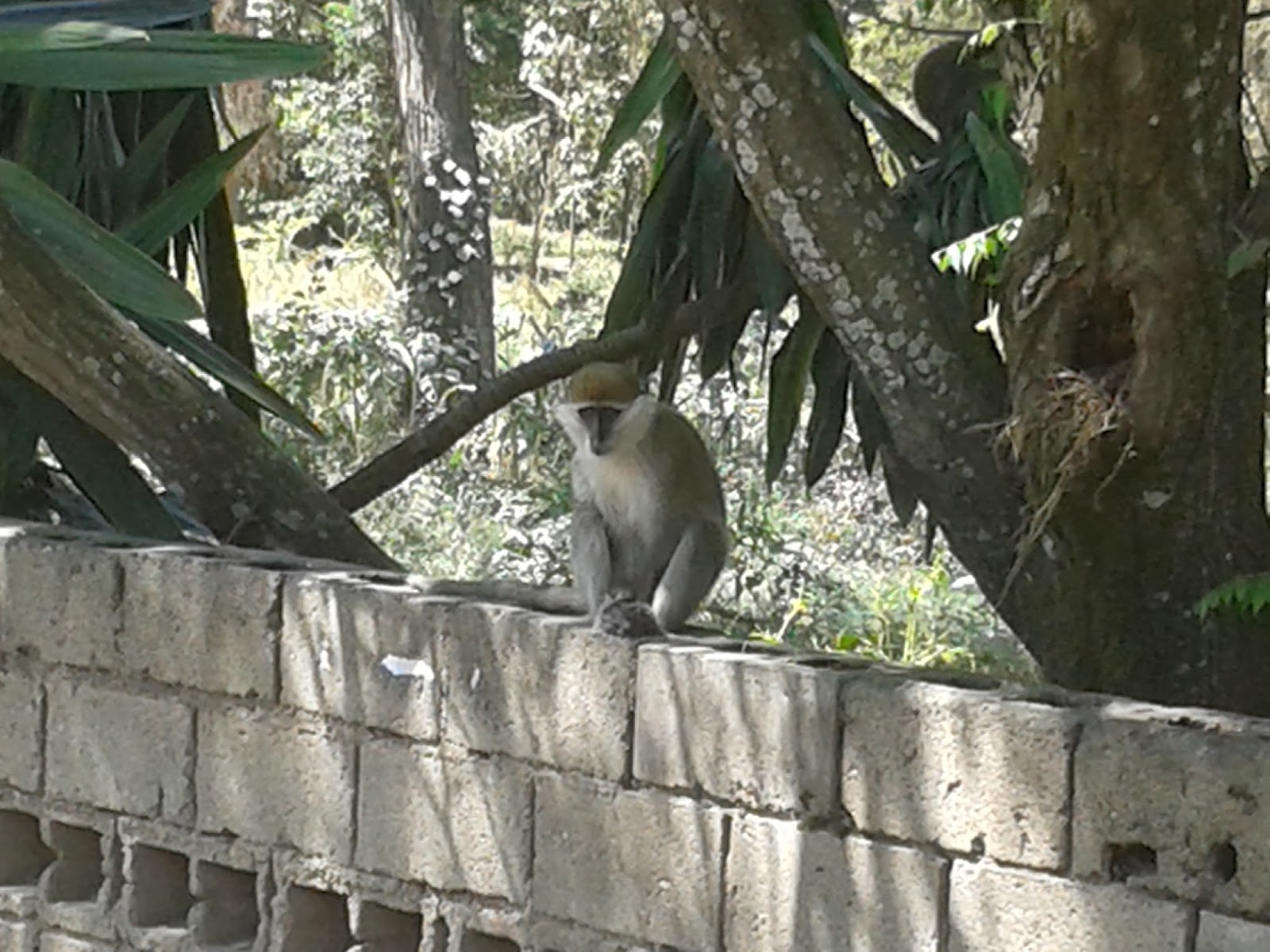
There has also been one other aspect of my life that has changed significantly and that is compound/house life in Hawassa. I have to be aware of the obnoxious monkeys that frequent my compound they are little thieves. If I were to relate them to an animal in America it would be a raccoon except monkeys have opposable thumbs. They get into and destroy everything. Below are some monkey pictures most of them were taken outside my door but I was also at a hotel one morning and they were creating havoc among the staff and guests at the hotel.  

Monkey at the hotel/restaurant. You can't really see it in this photo but he had found the kitchen and stolen a garlic clove

Naughty monkey at the table next to me


Monkey in compound tree... Hes hoping I'll leave my food


That is an avocado tree and he snatched a ripe avocado from the top of the tree

Monkey in compound looking for food near our table and chairs

Snoozing in the tree above my door

Wednesday, December 18, 2013

Hawassa, Ethiopia

After a very simple Thanksgiving and a successful week re-group with the entire Universal Immunizations through Improving Family Health Services (UI-FHS) staff I am finally in southern Ethiopia, Hawassa to be exact. I was hoping to spend this week out at my work location meeting more of the government staff however due to circumstances out of my control I have been stuck in Hawassa.  Not to fret though, as Hawassa is a beautiful city and this time has given me the opportunity to learn a bit more about the culture and people that live in Southern Ethiopia.

Unlike Mekele in Tigray, Hawassa is a resort town not only for foreigners who are here to bird watch and see the hippos but it is also a vacation destination for the locals. The city of Hawassa borders a beautiful lake and dormant volcano, in which there are a couple of miles of public walking paths that I like to frequent in the early afternoons. Southern Ethiopia is known as the “cash crop” area of the country, where almost all produce is grown that keeps Ethiopians and Peace Corps Volunteers alive, if this crop fails severely for multiple years in a row, famine sets in. I’ve also been lucky to have regular access to items such as bell peppers, passion fruit, cherry tomatoes, strawberries, green onions, and different varieties of lettuce. Items I really didn’t have access to up in Mekele.
Lake Hawassa about a 2 min walk from house

Right out my front window

My new living conditions are a step up from anything I've ever lived in before in fact I might be a bit spoiled as I have a hot shower and refrigerator. I know to most of you these are essential to our daily lives however these are extremely rare for Peace Corps Volunteers to have. I've been laughing at myself a bit because I am having to re-learn how to use a refrigerator again. I know what goes into a fridge in America but not in Ethiopia. I'm slowly realizing I can cook a larger quantity of a dish and put it in my fridge and then re-heat it the next day. I've pretty much mastered the one serving size meal and am readjusting a bit. 

Another funny story, I had been in my house about 8 days before I walked next door to visit with the Scottish couple in my compound, to learn that I can make ice in the top portion of my fridge. It had not occurred to me to make ice cubes yet. It was just unutilized space in the top of my fridge I almost thought of it as a waste of space.  I’ve lived in this country long enough to assume ice is just not an option. I then quickly realized I could buy a small bottle of local gin and some tonic quite inexpensively and make myself a cocktail occasionally in my house. What a wonderful discovery!

Work has slowed down a bit, as I’m in between case studies at the moment.  The NGO and I are still working on revisions and formatting etc, then it will be released to the Bill and Melinda Gates Foundation. Don’t really know what that means all I hope is that the information is helpful to the Federal Ministry of Health in Ethiopia in re-writing their immunization strategies.

Well below are some pictures of Hawassa. When I head out to my work location I’ll be sure to post those pictures as well.  
Inside my compound in Hawassa, I usually sit at that table and work, its under the avocado tree

Monkeys I see regularly


Friday, November 15, 2013

Work in Ethiopia

It’s been exactly 27 months since I first moved to the Tigray Region of Ethiopia. Its been a great experience living with the caring and curious people of Tigray. I have wrapped up my last case study in Tigray. The enlightenment I got from working at the lowest levels of the government system was probably a once and life time experience and I could not have done it without the assistance of the Non-governmental Organization (NGO) and my translator who helped me overcome the language barrier. When I talk with many Ethiopians about certain services provided here by the government I usually get the same response, “The government workers are lazy, and don’t do anything…They are working in a job in which they go have tea or coffee and talk with friends.” I find these statements rather curious because from what I’ve seen especially in the health sector in Tigray is that these are workers trying to do their jobs to the best of their abilities with the little resources they are provided.
Health Extension Worker giving a presentation on Malnutrition
The Health Extension Worker collecting documentation of the households
This was proven to me time and time again, working with county office staff, health center staff and again at the health post levels (ground level health services). My translator when we finished our work, said that the health staff that work in this county work very hard and are providing services to people who normally would not have access to these types of health resources and education. He was truly amazed at how hard they worked. I think he gained a bit of respect for what the government offices are trying to do, more than anything he became educated about was actually happening in the government system. He was just unaware as to how hard people really work.
Out Hiking

Just making sure our weight is healthy

The road in front of us

At the end of the month my time will end here in Tigray and I will get the opportunity to move to the southern livin’ of Ethiopia. I will be moving to Hawassa, the city capital of the Southern Nations region (SNNPR). This part of Ethiopia is much more diverse than Tigray. Originally the southern reagion was sectioned out into Tribal areas, each tribe speaking their own language and having their own cultures. Just living in a space about the size of New York there are 40 different tribes and languages.  I think it has been hard but now this area has been grouped into one region with all tribes living harmoniously in one region.


With this move comes new co-workers, new counterparts, and new government health offices to determine how immunization services in this part of Ethiopia function. I don’t know a whole lot about the area I’ll be working in other than its about 2.5 hours outside the capital city of Hawassa, its cold and wet and they speak 2 languages. I’m excited about the move and the challenges that await me. More to come on the move…  

Wednesday, October 23, 2013

Returning Back to Ethiopia...

I’ve been back from America now for just over a month and am really enjoying my third year in Ethiopia. While back home I truly enjoyed seeing family, hanging out with friends and eating good wholesome home cooked meals. Cooking in a proper kitchen again was wonderful and the use of a regular washer and dryer. We are very grateful to have all of those little luxuries that make America what it is today.

Since returning to Ethiopia I have pretty much settled into my Mekele house and love being in a big city with regular internet, electrical and anything I need. Lately, work has been going well with the Non-Governmental Organization (NGO).  Back in Adigudom (my 2 year placement site) I’ve been documenting the daily life of a Health Extension Worker (HEW). These young ladies are trained mostly in prevention and education as it relates to contraception, immunizations, and overall sanitation in the Ethiopian health system.
HEWs have the hardest job in the world, are paid very little for the services they provide, and still some of the most caring individuals I’ve met. Most HEWs walk several hours a day out in the weather elements going house to house educating some of the most rural individuals. Just yesterday, I went on a two hour hike with the translator and a local HEW to an outreach immunization session. It was a pretty amazing walk, up and down and around mountain sides. Then for the HEW it was six hours of providing vaccines to the local newborns in the community.
2 HEW at a Vaccination Session
HEW collecting documentation for the new Family Folder System

Another Vaccination Session

Hiking to a vaccination session

In addition, to observing several immunization sessions I was able to experience my first Polio Campaign. The neighboring country of Somalia is under civil unarrest and experiencing an awful famine. This has led to several thousands of Somali refugees coming into Ethiopia, which has brought several cases of polio outbreaks in Ethiopia. The World Health Organization decided to put on a polio campaign in Ethiopia to stop the spread of polio. That particular day I was also out with a rural HEW and I can officially say that was one of the hardest working days I’ve ever had, climbing down a mountain side and then going house to house to distribute polio vaccines to children under five. It sounds like there will be at least 2 more rounds of this polio campaign to make sure all children in Ethiopia are vaccinated against this disease.   

Polio Campaign (don't worry this is just the older sister to the infant)

Hike down into the valley for the Polio campaign

Checking for Malnutrition

In the weeks to come, with some anlaysis of the data I’m collecting I hope to help establish a solid defaulter tracing strategy and present that to the NGO. The county I’m working has done a great job at finding children who do not return to receive the rest of their vaccinations… More to come as it relates to this topic. 

Harvesting Grain

Sunday, June 30, 2013

Good Food and Good Company

Group 5 (Health and Education) Volunteers of Peace Corps Ethiopia are getting ready to wrap up their final last couple of months in Ethiopia. Usually this includes saying goodbye to friends, co-workers and sometimes “adopted” families and finishing up any work related projects.  Perhaps, the hardest goodbyes are those said to fellow Peace Corps Volunteers (PCVs) we spent 2 years with. The group 5 PCVs of Tigray, Ethiopia decided we were going to go out with a celebration. So “Pig-Fest” was held!  Yes, there was a Pig that was slaughtered and spit roasted over a fire, along with a few other wonderful home cooked delights. While Peace Corps (PC) may not be one of the easiest jobs anyone will ever have it certainly is one of the most rewarding experiences.


Below are a few pictures of “Pig Fest” and saying goodbyes
Group 5 Peace Corps Volunteers

Beautiful old women

Priests in Training 

Drive up to Atsbi for "Pig Fest"


The cook at work for "Pig Fest"

Cheese Cake!!!

Me and Brittany 

Girls of Tigray

Tigray Group 5 Education & Health 

The gift of a book is worth so much


Brendan enjoying the Pork

Sunday, June 2, 2013

Last Month at Site and 3rd Year Extension in Ethiopia

Well, its been officially 2 years since I’ve left the great US of A, May 26, 2013 to be exact. Quite an accomplishment as I’ve dodged crazy towns people, made some very close Ethiopian friends, taught a few co-works about American culture and ate, ate, ate. In the past two years I’ve made great strides in adaptation, flexibility and learned to overcome adversity. Two years in Ethiopia is a once in a life time experience and one many people can’t relate too. I truly do enjoy my allies here (aka white people) whom understand the types of situations we deal with on a daily basis. In the past month or so I took a trip to Arba Minch, attended/facilitated two trainings and participated in 1 COS (Close of Service) Conference. I’ve been on the road lately and am definitely ready to get back to site. 

Arba Minch was a fabulous trip, we saw lots crocodiles, hippos and zebras. I was traveling with a group that consisted of PCVs and a couple British individuals. I have never seen Ethiopia so green it was like traveling to a whole new world even with in the small country of Ethiopia. We also saw a few people from the different tribes at a market, which was very interesting. For those of you who do not know a whole lot about Ethiopia there are 80 different tribes each with its own language living within this small little country Almost all of the tribes live in the deep south of Ethiopia on small plots of land. 
Arba Minch Croc

Arba Minch Hippos
Compare this Southern Ethiopia picture to the one at the very top of this page,  Ethiopia is a very diverse place!
The first training I attended was a week-long training on Quality Improvement in the health system, more specifically the immunization sector. This was a rough training with well over 300 power point slides but it did include some important information. The final training was an experience share about work related issues in health for the new health PCVs in country.

Finally, Peace Corps held our completion of service conference, discussing our readjustment back to America, job opportunities, resumes, and saying our goodbyes to Ethiopia. This was definitely a bitter sweet conference because many of us are sad to leave our new homes but happy to be returning back to America.

In my two years here I have been doing some networking with a few NGO “Non-governmental organizations and had a great relationship with a particularly high functioning NGO in my town. I took this opportunity to work with this learning NGO on systems my county has implemented in the health sector and helped in documenting these practices. In my time with the NGO I was offered a 3rd year extension opportunity in Ethiopia with this NGO. Everything fell in place and I will be returning to Ethiopia for a 3rd year PCV/NGO prospect.

The NGO is called John Snow Inc. and the project I will be working most closely with is called Universal Immunizations through family Health Services (UI-FHS). This is a very unique NGO as all work must be implemented through the government offices and no additional funding can be used to improve supplies or increase salaries. So this means the NGO is really looking to improve the knowledge base of the already existing structures, again most specifically as it relates to immunization services.

Work with the immunization NGO 

This poor child is going to help in documenting immunization coverage in Ethiopia via a little blood draw
I will be living in 3 areas of Ethiopia so I anticipate several moves in the next year “I will be living out of a suit case.” The 3 areas of Ethiopia I will be in are Mekele, Tigray (not far from my current site), lake side in Hawassa southern Ethiopia, and finally the first volunteer in the Afar region in a city called Assaieta. Most of my work will be researching “best practices” being implement in these areas and also sharing some my already gathered information with the government staff of the other two areas. This is a fantastic extension opportunity and am looking forward to my third year in country. 

Sunday, April 7, 2013

All Volunteer Conference

All Peace Corps Volunteer Conference 

Lalibella & Howzen

Inside of a Howzen rock church 800 years before King Lalibella's rock churches
Rock Climbing (don't let go!)
Had to follow the priest up to the church
Deanna and I in Howzen
Had to rock climb up to this church
Howzen
A rock church outside of lalibella under a rock cliff
The Rock church of King Lalibella himself
                      Walking into one of the rock churches
Lalibella Church
Priests Praying

St. Jerges Church at Lalibella
Walking down into St. Jerges Church down inside of the rock

Inside of one of the rock churches in Lalibella
After All Volunteer Conference (AVC) I decided it was time to see a bit more of Ethiopia and so a fellow PCV and I took a trip to Lalibella. Ethiopians are deeply religious people and Lailbella is one of the most holiest places in the country.The town of Lalibella is named after King Gebre Meskal Lalibella reigning in the late 12th century and is famous for the monolithic rock-cut churches. There was a total of 13 rock churches built in clusters of 3-4 during the kings time. The craftmanship of the internal structures of these churches were amazing for the times. above are some pictures

Our final destination was a tiny village 3 hours north of Mekele called Howzen. It was said that Howzen was founded by a set of christian missionaries that came over during the reign of King Kaleb over 800 years before the time of King Laliballa. We went again to see a set of rock churches in the area. These rock churches are a bit different instead of the churches being separated from the rock entirely expect for the floor, like in Lalibella. These churches were built on cliff sides of rock mountains. So they entail a hike and a rock climbing portion till you finally reach the entrance to the church.  Then there is a hole you climb into to actually see inside the church. Also attached are some pictures. There are typically well preserved paintings on the sides of the walls and along the arches and are pretty amazing.